
What Is an Analytical Testing Lab? Definition, Scope & Use Cases
Learn what analytical testing labs do, how they support product safety and quality, and why they're essential in regulated industries like pharma and food.
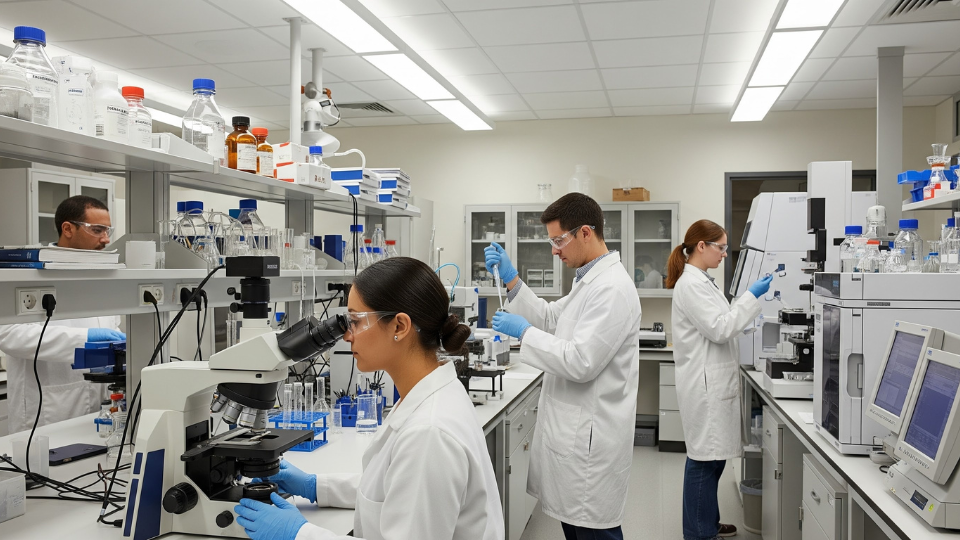
Analytical testing labs are central to the life sciences industry. They provide the critical data needed to validate products, meet regulatory standards, and ensure safety across the supply chain. Despite their behind-the-scenes role, these labs impact everything from the medicine you take to the food on your shelf.
This article explores what analytical testing labs do, how they operate, and where their value is most evident across industries.
Understanding What an Analytical Testing Lab Does
Analytical testing is the science of identifying and quantifying the components in a given sample. It isn’t limited to a single industry or product type—its purpose is to generate objective, traceable results that inform decision-making. Whether a manufacturer needs to confirm the concentration of an active ingredient or detect contamination down to parts per billion, analytical labs provide the precision and transparency needed to move forward with confidence.
These labs don’t just “run tests.” They operate within tightly controlled frameworks to ensure that every result meets the standards of reproducibility, accuracy, and regulatory compliance.
Define analytical testing and its purpose
Analytical testing refers to the suite of techniques used to examine the chemical, physical, or biological composition of a sample. These techniques provide measurable, validated data to confirm product specifications, detect impurities, or investigate stability over time.
While clinical laboratories focus on diagnosing patients, analytical testing labs work with materials, not people. Their clients range from pharmaceutical developers to cosmetics manufacturers, each requiring highly specialized testing to meet specific regulatory or commercial goals.
The output of analytical testing is often a Certificate of Analysis (CoA), a formal document that reports the quantitative findings of a given sample and whether it meets predefined criteria.
Industries served by analytical labs
- Pharmaceuticals and biologics
- Food and beverages
- Nutraceuticals and dietary supplements
- Cosmetics and personal care
- Environmental and industrial sectors
- Consumer goods and e-commerce platforms
Each sector operates under distinct regulatory bodies (FDA, Health Canada, EFSA, state agencies), requiring data that can stand up to legal and scientific scrutiny.
Common tests and instrumentation
- Chromatography: HPLC, GC-MS
- Spectroscopy: UV-Vis, FTIR, ICP-MS
- Microbiology: plate counts, PCR
- Physical chemistry: pH, viscosity, moisture, particle size
Method choice depends on analyte, matrix, detection limits, and regulatory thresholds. Labs routinely handle detection limits as low as ppb.
The Backbone of Accuracy: Processes in an Analytical Lab
Sample intake and chain of custody
From receipt, chain of custody tracks labeling, storage, and testing via LIMS. Integrity controls—temperature, tamper-evidence, documentation—are mandatory.
Method selection and validation
Labs select compendial or develop in-house methods. For new methods, validation covers accuracy, precision, specificity, linearity/range, LOD/LOQ—ensuring defensible results.
Instrumentation and analysis
Analysts calibrate instruments, run standards, and document system suitability and results in Part 11–compliant systems for audit-ready traceability.
Review, QA/QC, and final report
Analyst review, QA audit, and final reporting produce CoAs and documentation that tie methods to data, including handling of any OOS results.
Where Analytical Testing Makes the Biggest Impact
Product development and R&D
Supports compatibility studies, stability screens, and delivery system validation to focus resources on viable formulations.
Regulatory submissions and label claims
Provides validated data for NDAs, NHPs, food/supplement compliance—turning claims into defensible statements.
Contamination detection and recalls
Enables root cause analysis, batch scoping, and rapid, trace-level detection to prevent or minimize recalls.
Stability studies and shelf-life claims
Timepoint testing, degradant tracking, and physical property monitoring under real and accelerated conditions.
A Closer Look at Ayah Labs: Real-World Analytical Support
Enzyme analyses for formulation support
Assay development, validated methods, and rapid turnaround for enzymes like protease, amylase, and lipase—accounting for matrix and processing effects.
How Ayah Labs stands apart
- ISO/IEC 17025–aligned quality systems
- Clear timelines—most results under 10 days
- Expert scientists and custom studies
In Summary
Analytical testing labs provide the data that determines whether products proceed, adjust, or are recalled. At Ayah Labs, precision, transparency, and actionable interpretation are non-negotiable—we deliver validated results you can trust.