
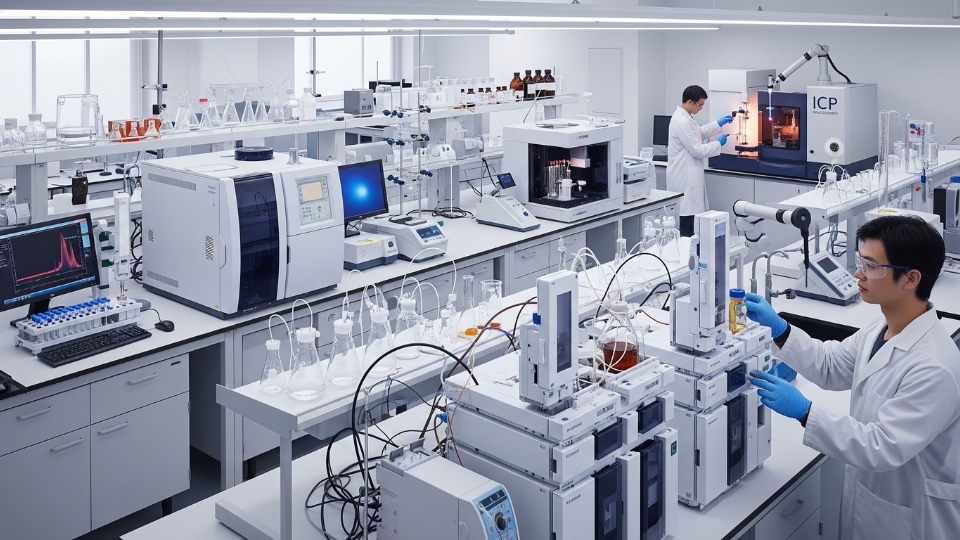
Types of Analytical Techniques Used in Analytical Testing Labs
Explore key lab techniques like HPLC, GC-MS, and ICP used in analytical testing to ensure accurate, reliable data for regulated product development and QA.
Analytical techniques are the foundation of modern laboratory science. They turn materials into measurable data, confirming what’s present, how much, and whether it meets the required standards. For anyone in pharmaceuticals, food, personal care, or environmental testing, understanding how these methods work is more than academic. It’s essential to producing safe, compliant, and high-quality products.
This article breaks down the major categories of analytical techniques used in today’s testing labs: how they work, what they’re used for, and how labs like Ayah Labs apply them to real-world challenges.
Why Analytical Techniques Matter in Lab Testing
Analytical testing isn’t about plugging samples into a machine. It’s about asking the right question, then applying the right method to get a precise, reproducible answer. Every test result you see on a Certificate of Analysis (CoA) is the product of careful technique selection, instrument calibration, and trained analysis.
The link between testing goals and technique selection
Each test method serves a different purpose. The technique used depends on:
- The goal of the test: identity, quantification, or trace impurity detection
- The matrix: powder, liquid, biological fluid; complex matrices can interfere
- Regulatory or commercial requirements: compendial vs. in-house methods
For instance, residual solvent testing in pharmaceuticals typically uses GC-MS, while quantifying vitamin content in supplements may call for HPLC. Choosing the wrong method, even if it’s technically sophisticated, can invalidate results.
Defining qualitative vs quantitative analysis
- Qualitative analysis identifies what is in the sample.
- Quantitative analysis determines how much is present.
In many regulated industries, both types are needed—for example, confirming a botanical identity (qualitative) and verifying actives meet labeled concentrations (quantitative).
Method validation and fitness-for-purpose
Technique selection doesn’t stop at instrumentation. The chosen method must be validated to perform reliably under specific conditions.
- Accuracy, precision, and specificity
- Linearity and range
- LOD and LOQ
Labs often use compendial methods (USP, EP, AOAC) but may need in-house development for novel compounds or complex formulations.
High-Performance Liquid Chromatography (HPLC)
HPLC is adaptable and widely used for quantifying compounds across industries.
How HPLC works
Separation occurs based on analyte interactions with a stationary phase and a liquid mobile phase, detected via UV/Vis, PDA, or MS.
Isocratic runs use fixed solvent composition; gradient runs change composition for complex mixtures.
Typical applications
- API assay and impurity profiling
- Nutraceutical standardization
- Stability testing
Pros and limitations
- High sensitivity, regulatory acceptance, broad applicability
- Less suited to volatile analytes; requires development/validation; sample prep effort
Gas Chromatography–Mass Spectrometry (GC-MS)
Preferred for volatile, thermally stable compounds and ultra-trace detection.
Principles
GC separates with a heated capillary column and inert carrier gas; MS provides mass spectral identification (single quad or MS/MS).
Use cases
- Residual solvents (ICH Q3C)
- Pesticides in food/herbals
- Fragrance components; environmental VOCs
Strengths and challenges
- Exceptional sensitivity and structural IDs
- Requires volatility/derivatization; maintenance and expertise needed
Inductively Coupled Plasma Mass Spectrometry (ICP-MS)
For trace metals at ppb to ppt levels.
How it works
Argon plasma ionizes elements; mass analyzer (quadrupole/TOF) measures m/z to quantify.
Applications
- Heavy metals in pharma, nutraceuticals, cannabis
- Water quality and raw material purity
- Trace minerals in foods
Strengths and challenges
- Extremely low detection limits; multi-element capability
- Costly; potential interferences; requires ultra-clean prep
UV-Visible Spectrophotometry (UV-Vis)
Fast, accessible quantification when compounds absorb in UV/Vis range.
- Colorimetric assays; raw material ID
- Nucleic acid/protein quantification
- Dissolution testing where applicable
Pros: speed and simplicity. Drawbacks: limited specificity and sensitivity vs. chromatography or MS.
Infrared Spectroscopy (FTIR)
Rapid, non-destructive identity confirmation via molecular “fingerprints.”
- Raw material ID (GMP), polymer analysis
- Fragrance/contaminant identification
Best for ID; not typically quantitative or trace-sensitive.
Enzyme-Linked Immunosorbent Assay (ELISA)
Highly specific detection of proteins, allergens, hormones.
- Food allergen panels
- Residue testing and biomarker quantification
Sensitivity to ng/mL, but requires high-quality antibodies and careful validation.
Other Techniques to Note
Karl Fischer Titration (moisture)
Preferred for trace moisture in solids and liquids; key in pharma, oils, and food.
Total Organic Carbon (TOC)
Measures carbon in water; used in cleaning validation and ultrapure systems.
Nuclear Magnetic Resonance (NMR)
Structural elucidation and identity confirmation; less common for routine testing.
How Ayah Labs Uses Analytical Techniques to Support Clients
We select and validate techniques based on the client’s goals, matrix, and regulatory context—not just instrument availability.
Real-world example: HPLC for shelf-life and API degradation
- Suitability screening for API and degradants
- Custom HPLC method development and validation
- Accelerated and real-time stability testing
Flexible support model
- Startup guidance on testing strategies
- Enterprise-scale validation programs
- R&D exploratory method work
In Summary
Analytical techniques aren’t interchangeable. The right choice depends on analyte, matrix, and question. At Ayah Labs, we bring both instrumentation and scientific reasoning to deliver precise, defensible results.