
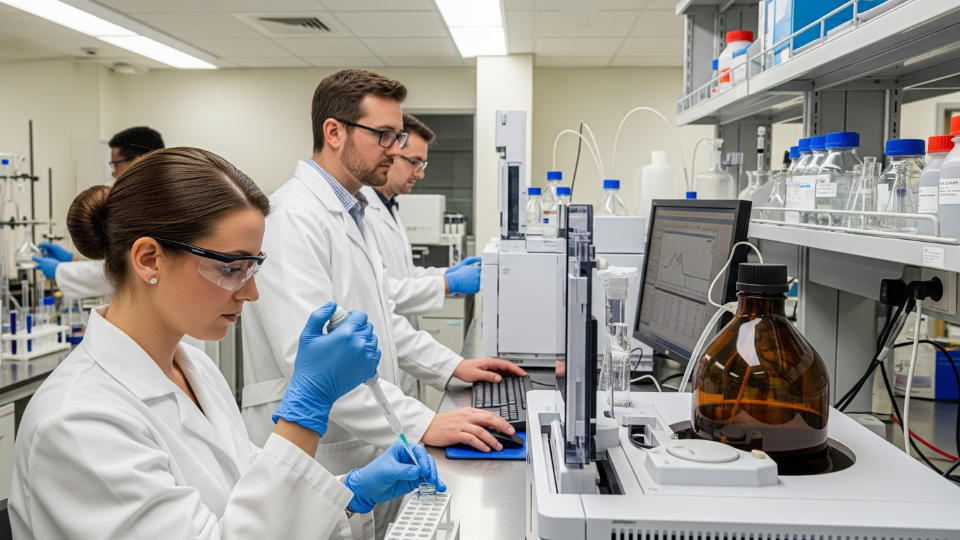
Analytical Method Development & Validation in an Analytical Testing Lab
A practical guide to analytical method development and validation, with real-world steps, best practices, and how AYAH Labs supports compliant lab testing.
In analytical testing, the methods used to measure chemical or biological substances aren’t chosen randomly.
They are built deliberately, step by step, until they consistently deliver results you can trust across instruments, analysts, and time. This article breaks down the foundations of method development, how it’s applied, and why it’s essential in regulated lab environments.
Understanding Analytical Method Development
Developing a reliable analytical method means building a procedure that consistently produces valid data for a specific analyte in a defined matrix. This section explains what method development is, why it matters, and how different methods and regulations intersect.
What analytical method development means
Analytical method development refers to designing and optimizing a procedure that can accurately and precisely measure a target compound or property in a sample. This is especially important in sectors like pharmaceuticals, food testing, and cosmetics, where data must stand up to regulatory scrutiny.
A well-developed method should be:
- Selective and specific to the analyte of interest
- Sensitive enough to detect low concentrations
- Reproducible across different analysts and equipment
- Suitable for the sample matrix
Distinction between qualitative and quantitative methods
There are two broad types of analytical methods, each serving a different purpose:
- Qualitative methods answer what is present. These are used for identification. For example, Fourier-transform infrared spectroscopy (FTIR) might be used to confirm the presence of a particular polymer.
- Quantitative methods determine how much of a substance is present. These require calibration, controls, and precision, common in techniques like HPLC or LC-MS/MS.
Choosing the right method depends on the goal of the analysis, regulatory expectations, and matrix complexity.
Common techniques used in modern labs
Analytical labs work with a range of instrumentation, often adapting techniques to suit specific client needs. These include:
- High-Performance Liquid Chromatography (HPLC) – used for purity, assay, and content uniformity
- Gas Chromatography (GC) – suitable for volatile compounds and residual solvent analysis
- LC-MS/MS – highly sensitive and specific, often used in pharmaceutical and PFAS testing
- UV-Vis Spectroscopy – good for rapid, low-cost quantification when appropriate
- FTIR and Raman Spectroscopy – used for identification, especially in raw material testing
Each technique has trade-offs in terms of sensitivity, specificity, run time, and required sample prep.
Regulatory frameworks that guide method development
Analytical method development doesn’t exist in a vacuum. Labs must align methods with current regulatory expectations, such as:
- USP and EP (United States Pharmacopeia / European Pharmacopeia)
- ICH Q2(R1) – guideline for method validation
- FDA Guidance for Industry – important for method validation in drug submissions
- ISO/IEC 17025 – the gold standard for lab quality systems, emphasizing method validation, uncertainty, and traceability
Labs like AYAH Labs operate within these frameworks to meet client expectations and regulatory requirements without compromise.
Step-By-Step Process of Method Development
Building a robust analytical method is never a one-size-fits-all process. It’s iterative, data-driven, and rooted in both scientific logic and practical constraints.
Defining method objectives and matrix
Before touching an instrument, analysts must define exactly what needs to be measured and where it lives. Every method starts with:
- The analyte of interest
- The matrix
- Required sensitivity and range
- Regulatory context
These answers shape the rest of the development strategy.
Choosing the right instrumentation and detection
Selecting the analytical technique is driven by the analyte’s chemistry, the complexity of the sample, and the level of detection required.
- Volatile compounds → GC with FID or MS
- Thermally unstable compounds → HPLC or LC-MS/MS
- Low-level impurities or contaminants → Tandem MS
- Simple identification in raw materials → FTIR or Raman
Instrumentation also matters for compliance, especially when the method is to be validated under FDA or ICH expectations.
Method optimization and preliminary studies
Once the basic setup is chosen, optimization begins. Typical activities include:
- Mobile phase tuning
- Column selection
- Detection parameters
- Sample prep protocols
Analysts run multiple trials during this phase, checking for peak shape, resolution, baseline noise, and run time.
Assessing initial performance characteristics
- Linearity and range
- Precision
- System suitability
If a method struggles to pass these early checks, it’s adjusted or rebuilt.
Analytical Method Validation – Scope and Process
Method validation establishes, with data, that a procedure is suitable for its intended use.
What method validation covers
Validation confirms a method’s performance characteristics and is a regulatory expectation across industries. At AYAH Labs we validate in alignment with ISO/IEC 17025, ensuring traceability from calibration through analyst competency.
Understanding ICH validation parameters
- Specificity – distinguish analyte from interferences
- Linearity – proportional response within range
- Accuracy – closeness to true value
- Precision – repeatability and intermediate precision
- LOD/LOQ – detection and quantitation limits
- Robustness/Ruggedness – tolerance to small deliberate changes
Documenting and reporting validation
Validation reports include a protocol, raw data, acceptance criteria, and conclusions. These documents are critical for audits and regulatory reviews.
Stability-indicating and forced degradation studies
Stability-indicating methods differentiate intact compounds from degradation products. Forced degradation (heat, light, oxidation, pH) helps establish this capability.
Challenges and Best Practices in Method Development & Validation
Common challenges labs face
- Matrix effects
- Instrument variability
- Low analyte recovery
- Co-elution
- Method transfer between labs
Best practices for building reliable methods
- Develop with validation in mind
- Design for robustness
- Document everything
- Include a second analyst for intermediate precision
- Calibrate frequently
Preparing for regulatory audits and inspections
- Validation protocols and reports
- Change control logs
- Analyst training records
- Instrument calibration and maintenance records
- Deviations and investigations
AYAH Labs’ Approach to Method Development & Validation
At AYAH Labs, method development is a core service grounded in ISO/IEC 17025 and built for pharmaceuticals, nutraceuticals, food, cosmetics, and environmental science.
Our scientific process
- Select optimal instrumentation and detection approach
- Perform feasibility assessments with matrix-matched samples
- Iteratively optimize parameters
- Validate to ICH Q2(R1) and ISO/IEC 17025 expectations
- Provide full documentation ready for audits
Case example: Physical chemistry analyses
Precision and reproducibility are essential for pH, viscosity, moisture, density, and refractive index. Methods are tailored to sample type, whether an oily emulsion or protein-rich drink.
Why clients trust AYAH Labs
- Responsiveness without shortcuts
- Regulatory fluency
- Customization to matrix and compliance needs
- Transparency with protocols, raw data, and rationale
Work with us
If you need a custom analytical method—or if your current method isn’t working across sites or batches—AYAH Labs can help.
- Consultations to scope project goals
- Tailored method development and validation workflows
- Full documentation packages for regulatory and QA use
- A scientific team that listens before it tests
Whether you’re scaling a new formulation, troubleshooting an assay, or validating your first commercial product, AYAH Labs is your partner in science.